

Ep #54: HTTP vs. WebSockets: Choosing the Right Channel for Your System
A deep dive into how communication models impact user experience and backend performance.

Breaking the complex System Design Components
By Amit Raghuvanshi | The Architect’s Notebook
🗓️ Oct 31, 2025 · Premium Post·
The Question
When should HTTP be used over WebSockets, and vice versa?
Why Read This Article?
Choosing between HTTP and WebSockets is critical for building efficient, scalable, and real-time web applications. This article breaks down their trade-offs, stateless simplicity vs. low-latency bidirectional communication with clear examples, practical use cases like Slack’s hybrid model, and a visual sequence diagram. Whether you’re designing REST APIs, real-time chat apps, or exploring protocols like WebRTC, you’ll gain actionable insights to make informed decisions and optimize your application’s performance.
The Answer
HTTP is a stateless, request-response protocol that powers most web applications and REST APIs1. It's simple, scalable, and universally supported by browsers, servers, proxies2, and CDNs.
Ideal for typical CRUD operations, form submissions, JSON APIs, or any scenario where real-time communication is not required.
WebSockets enable persistent, full-duplex communication between client and server. After the initial HTTP handshake3, a TCP connection is kept open, allowing real-time push and pull of data in both directions.
Common use cases of WebSockets:
Chat applications
Multiplayer games
Live dashboards or streaming updates (e.g., stock tickers, notifications)
However, WebSockets introduce complexity:
Load balancing sticky sessions
Firewall or proxy traversal
Connection lifecycle and resource management
Detailed Explanation:
HTTP: The Stateless Workhorse
How It Works: HTTP (Hypertext Transfer Protocol) is the backbone of the web, operating on a request-response model. A client (e.g., a browser or app) sends a request to a server, which processes it and sends a response. Each request-response cycle is independent, making HTTP stateless, no persistent connection4 is maintained between requests unless explicitly managed (e.g., via cookies or sessions).
Protocol Mechanics:
Built on top of TCP (Transmission Control Protocol), HTTP establishes a connection for each request, which is typically closed after the response is sent (HTTP/1.1 introduced "keep-alive" to reuse connections for multiple requests, but it’s still not persistent in the same way as WebSockets).
HTTP/2 improves efficiency with multiplexing5 (multiple requests over a single connection) and header compression6, but it remains request-response-based.
HTTP/3, built on UDP7 (via QUIC8), further optimizes latency and connection handling but retains the stateless model.
Common methods: GET, POST, PUT, DELETE, etc., used in RESTful APIs.
Key Characteristics:
Stateless: Each request is independent, simplifying server design and scaling.
Universal Support: Works across all browsers, servers, proxies, CDNs, and firewalls9.
Scalable: Statelessness allows load balancers to distribute requests across servers without needing to track client state.
Resource-Efficient for Short Interactions: Ideal for infrequent or one-off requests (e.g., loading a webpage, submitting a form).
Use Cases:
Fetching static or dynamic content (e.g., web pages, JSON APIs).
CRUD operations (Create, Read, Update, Delete) in REST APIs.
File uploads/downloads.
Authentication flows (e.g., OAuth token requests).
Scenarios where real-time updates are not critical (e.g., e-commerce checkout).
Advantages:
Simplicity: Well-understood, with mature tools and frameworks (e.g., Express, Django, Spring).
Compatibility: Works seamlessly with existing web infrastructure (proxies, CDNs, etc.).
Scalability: Stateless nature makes it easy to scale horizontally with load balancers.
Low server overhead for short-lived requests.
Limitations:
No Real-Time Push: Servers cannot initiate communication to push updates to clients without additional mechanisms (e.g., polling).
Latency for Frequent Updates: Polling (repeatedly sending HTTP requests to check for updates) is inefficient and increases server load.
Connection Overhead: Each request may require establishing a new TCP connection (mitigated somewhat by HTTP/2 and HTTP/3).
Over time, while writing The Architect’s Notebook, I realized there’s another kind of architecture we often overlook — the one inside our own minds.
That realization led to my new publication, The Mind’s Blueprint — a space where I write about awareness, simplicity, and the architecture of the inner world.
It’s not about escaping reality, but about seeing it with more clarity and peace.
If The Architect’s Notebook helps you build better systems, The Mind’s Blueprint will help you understand the mind that builds them.
✨ Subscribe to The Mind’s Blueprint and walk with me on this journey of unblocking the mind.
WebSockets: The Real-Time Powerhouse
How It Works: WebSockets provide a persistent, full-duplex10 communication channel over a single TCP connection. They start with an HTTP handshake (using the Upgrade header to switch from HTTP to the WebSocket protocol, ws:// or wss:// for secure connections), after which the connection remains open, allowing both client and server to send messages at any time.
Protocol Mechanics:
After the handshake, the connection uses a lightweight framing protocol to send messages (data frames) in both directions.
Messages can be text (e.g., JSON) or binary, with minimal overhead compared to HTTP.
The connection stays open until explicitly closed by either party or disrupted (e.g., network issues).
WebSockets use ping/pong frames11 to maintain the connection and detect disconnections.
Key Characteristics:
Full-Duplex: Both client and server can send data simultaneously, enabling real-time bidirectional communication.
Low Latency: Persistent connections eliminate the overhead of repeated handshakes.
Stateful: The server must maintain the connection state for each client, which can increase memory usage.
Event-Driven: Ideal for scenarios where updates need to be pushed instantly (e.g., chat messages, live game moves).
Use Cases:
Real-time chat applications (e.g., Slack, WhatsApp).
Multiplayer online games (e.g., real-time strategy or FPS games).
Live dashboards (e.g., stock tickers, sports scores, monitoring systems).
Collaborative tools (e.g., Google Docs, Trello).
Push notifications or live updates (e.g., social media feeds, IoT device monitoring).
Advantages:
Low Latency: Ideal for real-time applications where delays are unacceptable.
Efficient for Frequent Updates: Eliminates the need for polling, reducing server load in high-frequency scenarios.
Bidirectional: Servers can push updates without waiting for client requests.
Flexible Data Formats: Supports JSON, binary, or custom protocols.
Limitations:
Complexity: Requires managing connection lifecycles (e.g., handling disconnects, reconnections).
Scalability Challenges: Persistent connections consume server memory and require sticky sessions or specialized load balancing.
Compatibility Issues: Some proxies, firewalls, or CDNs may block WebSocket connections (especially older infrastructure).
Resource Intensive: Each open connection consumes server resources, limiting scalability for thousands of concurrent users.
Trade-off:
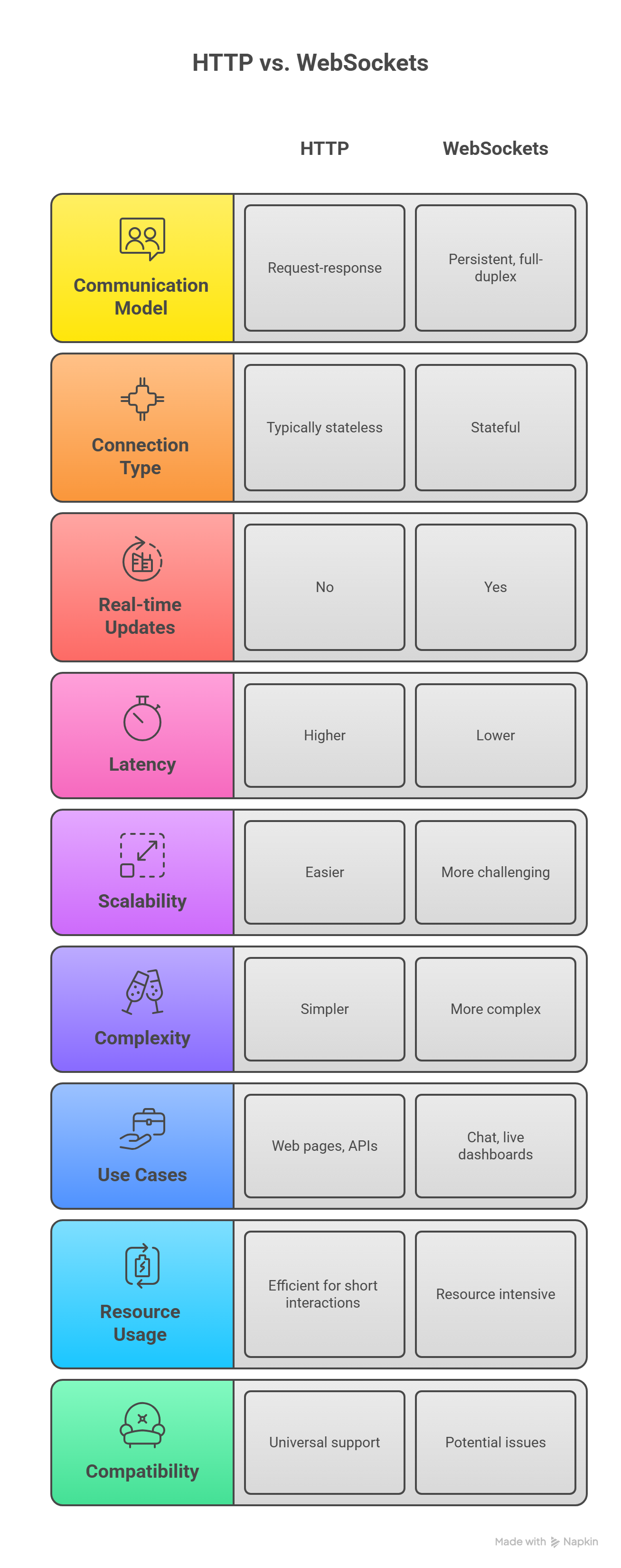
Simplicity and statelessness vs. low-latency bidirectional communication
Diagram
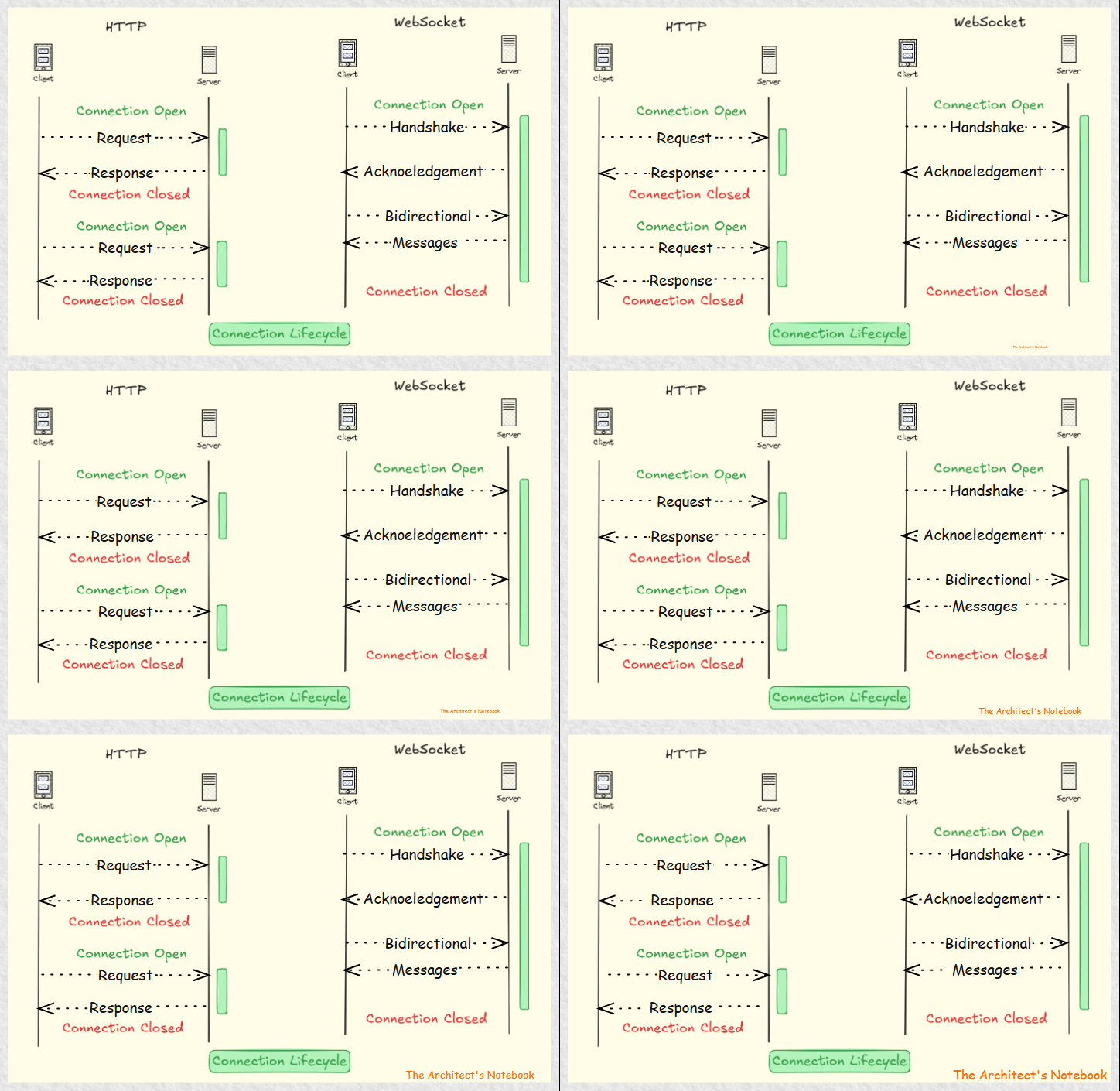
HTTP Path: Client initiates a request, server responds, and the connection closes (or is reused with keep-alive).
WebSocket Path: Client initiates an HTTP handshake, upgrades to a WebSocket connection, and maintains bidirectional communication until closed.
🔐 This post is part of a premium series designed to sharpen your system design thinking.
Only premium members get full access to Premium Posts👉 Become a premium member now via Gumroad:
🔒 What You Get in the Premium Post
For readers ready to dive deeper, the Premium Post unlocks:
Technical Deep Dive: Implementation Details
Understand the underlying mechanisms of HTTP and WebSocket connections.
Learn how to implement both using modern frameworks (Node.js, Python, .NET, etc.).
Covers connection handling, message structure, and state management.
Performance Benchmarks
Compare latency, throughput, and network efficiency between HTTP and WebSockets.
Real-world performance graphs and metrics.
Code Walkthroughs
Practical code examples for:
Setting up a WebSocket server and client
Building a REST API with HTTP
Handling edge cases (timeouts, retries, reconnects)
Visual Sequence Diagrams (Deep Dive)
Full protocol-level sequence diagrams showing:
Connection establishment
Message exchange flows
Lifecycle management
Clear side-by-side comparisons of HTTP vs. WebSocket behavior
and more