

Vertical vs Horizontal Scaling — Real Trade-offs
Why "boring" big servers usually beat complex microclusters

One concept, clarified in 2 minutes
By Amit Raghuvanshi | The Architect’s Notebook
🗓️ May 9, 2026 · Free Edition ·
Announcement
I’ve just hit ‘Publish’ on Volume 1(B): The Architecture of Neural Scale.
While Volume 1(A) was all about the raw engine (the hardware and physics), this volume is where it all comes together into a real system.
We’re talking 650+ pages covering:
• Vector DB Internals (HNSW, PQ, and sharding)
• The RAG Blueprint (from semantic chunking to reranking)
• AI Gateways & Resiliency (how to stop your system from crashing when the GPU OOMs)
• The Economics of Scale (FinOps for AI)
I’ve also added something new to this volume: Architect-level interview questions at the end of every chapter. If you’re preparing for a Staff/Principal role, these are exactly the kind of trade-off discussions you need to master.
Launch Special: For the next two weeks, the book is 10% off ($35.10).
The Cloud-Native Trap
“Move it to Kubernetes.” “Just spin up more pods.”
This is the default answer for scaling today. Horizontal scaling (scaling out) has become a religion in the tech industry.
But here is a secret that cloud providers rarely advertise: You probably don’t need a distributed system. You might just need a bigger computer.
Let’s break down the real, unvarnished trade-offs between Vertical Scaling (scaling up) and Horizontal Scaling (scaling out), and why the “boring” approach is often the most profitable.
The Allure of Horizontal Scaling
Horizontal scaling is conceptually beautiful. If one server handles 1,000 users, 10 servers handle 10,000 users.
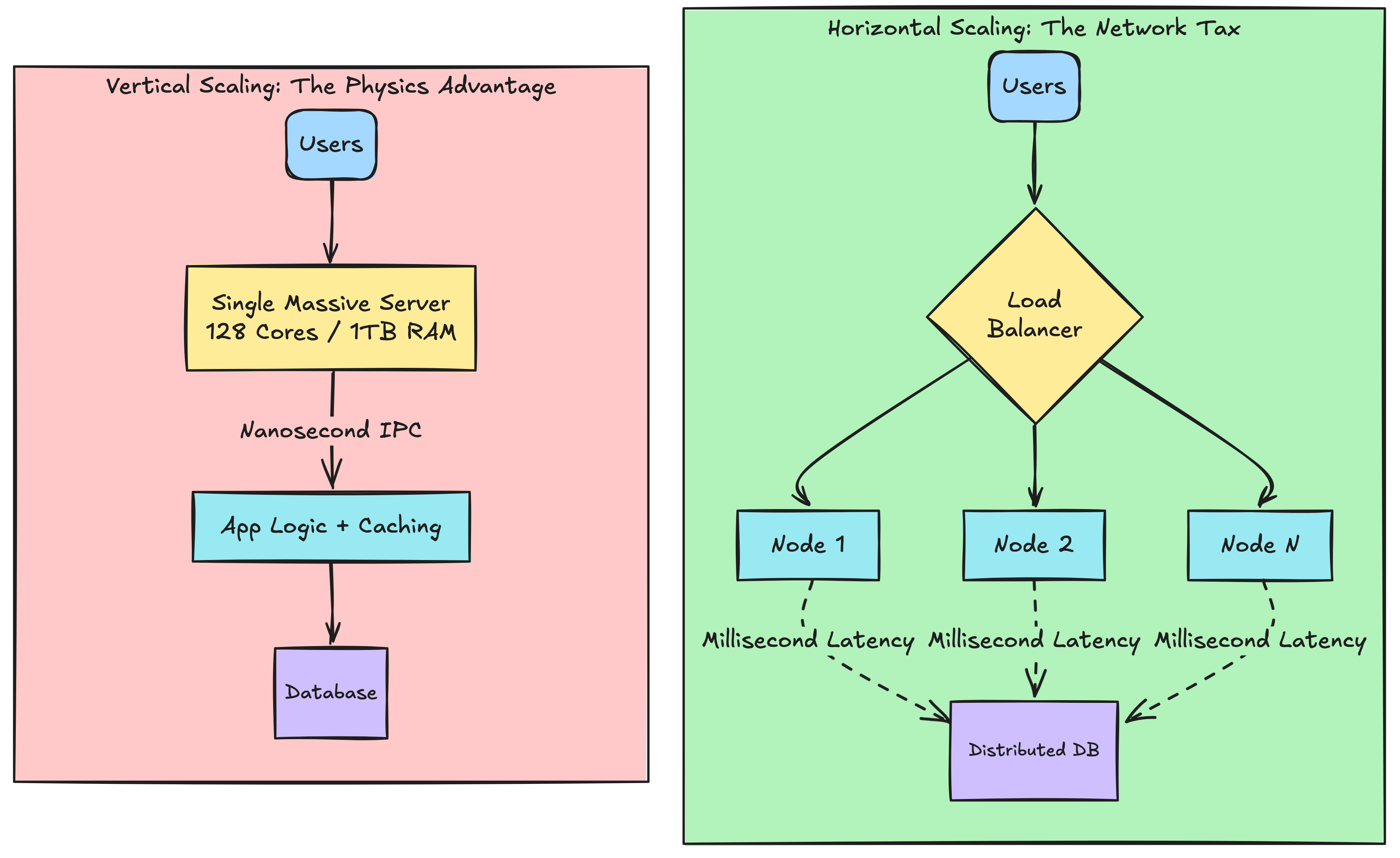
The Promise: Infinite scale and High Availability. If Node 3 crashes, the Load Balancer simply routes traffic to the remaining nodes.
The Reality: You just opted into the Distributed Systems Tax.
When you split your app across multiple servers, you no longer have one system; you have a network. You now have to manage distributed state, session affinity (sticky sessions), network partitions, and complex CI/CD pipelines.
The Physics of Vertical Scaling
Vertical scaling means turning off your 4-core virtual machine and turning on a 64-core machine.
The ultimate advantage here is Physics. Inside a single machine, your application components communicate via the CPU bus and RAM (Inter-Process Communication). This takes nanoseconds. When two separate servers communicate over a Gigabit network, it takes milliseconds.
A network hop is roughly 1,000,000 times slower than a local memory read.
The Real Trade-offs Architects Consider
When deciding how to scale, Architects don’t just look at code; they look at the balance sheet.
1. Hardware Cost vs. Engineering Cost AWS will happily rent you a server with 192 CPU cores and 1.5 Terabytes of RAM. Yes, that single machine is expensive. But do you know what is drastically more expensive? A team of 5 Senior Engineers spending four months migrating a monolithic database to a sharded, horizontally scaled architecture. Hardware is cheap. Developer time is expensive.
2. The Availability Myth The most common argument against Vertical Scaling is: “It’s a Single Point of Failure!” This is only true if you have exactly one machine. Smart vertical scaling relies on an Active-Passive setup. You have two massive machines. One handles 100% of the traffic; the other is a hot standby. If the active machine dies, the IP address flips to the passive one. You get 99.9% availability without writing a single line of distributed consensus code.
3. The Point of Diminishing Returns Vertical scaling has a hard physical ceiling. You cannot buy a machine larger than what Intel or AMD can manufacture. If your database requires 100 Terabytes of active memory, vertical scaling is no longer an option. This is the only time you are truly forced to scale horizontally.
The Lesson: Horizontal scaling is for when you run out of physics. Vertical scaling is for when you want to ship features instead of debugging network partitions.
Scale up until it hurts. Then, and only then, scale out.
Until next time, The Architect’s Notebook
P.S. If you do hit the physical ceiling and have to scale horizontally, your Load Balancer becomes your most critical piece of infrastructure.