

🔓 The Architecture of Secure Thinking — It’s Here

Yesterday, I said something new was coming — a project that began with a single question:
“Where does trust really begin in a system?”
Today, I can finally tell you what that project is.
What It Is
It’s a book — but not an ordinary one.
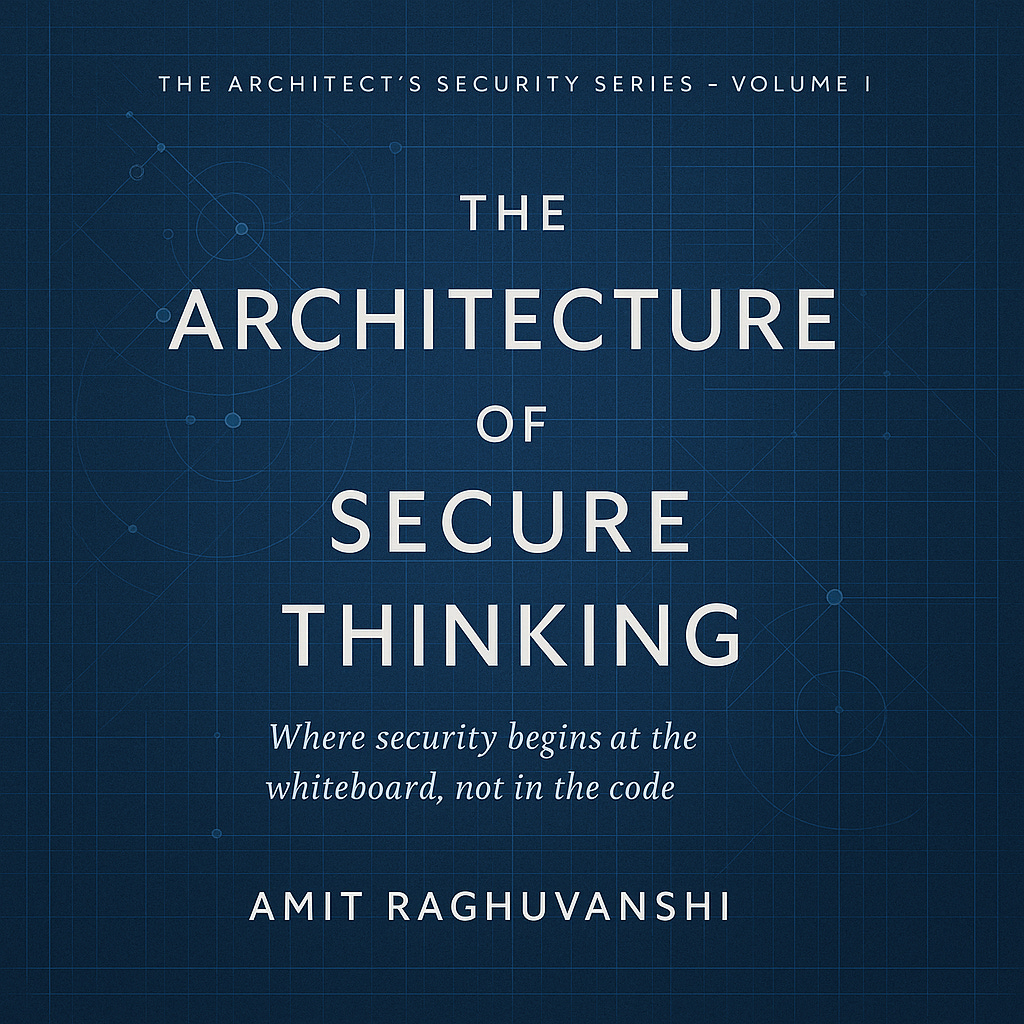
The Architecture of Secure Thinking
Volume 1 of The Architect’s Security Series
A 600-page deep dive into how security emerges from design, not from patches or tools.
It’s the first complete framework that treats system security as an architectural discipline — written for the people who design, build, and review large-scale systems.
Why I Wrote This Book
For years, I noticed a gap between how we design systems and how we secure them.
Architects talk about scalability, caching, replication, latency — but “security” usually enters the conversation later, during testing or audit.
By then, the design decisions that matter most are already locked in.
And so, the same vulnerabilities appear again and again.
Not because we can’t code safely, but because we rarely design with security in mind.
This book was born to close that gap — to bring OWASP thinking and system-design reasoning together in one place.
Why This Volume Exists
The Architecture of Secure Thinking is the first step in a larger journey — the foundation of The Architect’s Security Series.
It exists to answer one question:
What would system design look like if security were considered from the very first diagram?
Rather than beginning with OWASP categories or exploit examples, this volume explores the design roots of security — how decisions about data flow, availability, and system boundaries create or prevent entire classes of vulnerabilities.
It bridges two worlds:
The architect’s world of scalability, trade-offs, and reliability.
The security engineer’s world of trust, exposure, and defense-in-depth.
What Makes It Different
There are brilliant OWASP guides.
There are great books on distributed systems and reliability.
But they live in separate worlds.
This book unites them.
It shows how threats emerge from architectural trade-offs, not just from bad syntax.
It reframes common issues — injection, data exposure, trust boundaries — as design phenomena, not coding mistakes.
It’s designed to be a single reference for anyone building or reviewing large-scale systems:
Architects defining component and data-flow layers
Developers integrating APIs and services
Security reviewers tracing risks in diagrams
You don’t need five books, three frameworks, and endless PDFs.
You need one cohesive lens that shows where security lives inside architecture.
That’s what this book gives you.
Why Secure Thinking Matters
Security isn’t a product to be added later; it’s a property that must emerge from structure.
Modern systems are distributed and composable — APIs talk to APIs, services call third-party platforms, and user data flows through caches, logs, and analytics pipelines.
Each boundary — every serialization, redirection, or configuration — is a potential fault line where trust can fracture.
Volume 1 begins at that fracture point.
It does not tell you how to patch vulnerabilities; it shows you how to design so that vulnerabilities never form.
How This Book Can Help You
Understand vulnerabilities at design time — before they reach production.
Map security to architecture layers — from data flows to availability zones.
Design for CIA (Confidentiality, Integrity, Availability) without sacrificing scalability.
Apply secure patterns for caching, throttling, validation, and secrets management.
Conduct security-aware design reviews with ready-to-use checklists and diagrams.
In short:
If you design systems that must stay online, reliable, and safe — this book is your field guide.
✳️ Excerpt from Chapter 1 — “Security as a Design Problem, Not a Patch”
“If security is an afterthought, it will become an aftershock.”
Most organizations still treat security as a reaction, not a design principle.
A breach occurs, a patch is released, a ticket is closed — and the cycle repeats.
But by the time you’re patching, the architecture has already failed.
Vulnerabilities rarely stem from a bad password or a missing validation.
They emerge from early design assumptions — a trusted microservice, an open API, a shared database that blurs boundaries.
When you draw your first box-and-arrow diagram, you’ve already defined your security posture.
Each box marks a trust zone; each arrow, a potential exploit path.
Those early choices — how data flows, how identities are verified, where boundaries lie — decide whether your system will resist or invite compromise.
Security is not a checklist of features.
HTTPS, encryption, tokens, and captchas are tools, not guarantees.
Security is a property that arises from how components interact — from the integrity of your design, not the quantity of your controls.
Two systems may use the same encryption algorithm; only one is truly secure, because its architecture protects the key, enforces rotation, and limits exposure.
Secure architecture is a shared discipline.
Architects define the boundaries, developers preserve them, and reviewers test the assumptions beneath them.
Together, they create a system that anticipates failure instead of denying it.
In modern distributed systems — clouds, APIs, and AI pipelines — every connection is a new frontier of trust.
Misconfigured IAM roles, over-privileged services, and unsegmented data flows are not coding bugs; they are design flaws waiting to surface.
The shift begins when teams stop fixing incidents and start designing for resilience and containment.
Because in the end, security isn’t a layer you bolt on —
it’s the pattern you weave into the design itself.
📖 Read the Free Sample
You can download the free 30-page sample — including the Preface, the summary of first chapter, and the design checklist:
🧠 Get the Complete Book
🌏 Launch Offer (Global):
The Architecture of Secure Thinking – Volume 1
📘 600 pages · PDF · Includes diagrams & checklists
Launch offer: $39 (regular $59) + Tax
Limited-time offer: Available at the launch price for two weeks only — ending on November 25.
🇮🇳 For Indian Readers:
The India Edition of The Architecture of Secure Thinking is available at a special regional price of ₹3,000 for the first two weeks of launch — ending on November 25.
Regular price: ₹5,000
Payment accepted via UPI.
After payment, you’ll receive the full 600-page book (PDF) by email within 24 hours.
📩 To request the UPI link or invoice, email thearchitectnotebook@gmail.com with the subject line “Volume 1 – India Edition.”
In Summary
This is the first comprehensive guide that connects system design and security at scale — a single place where architects, developers, and reviewers can learn to design systems that are secure because of their structure.
Security isn’t a layer you add later.
It’s a lens you use from the very first line drawn on the whiteboard.
Welcome to The Architecture of Secure Thinking.
The journey begins here.
🜂 Amit
This sounds really useful! The stuff I build typically involves multiple APIs.