

System Design Insight: Stateless vs Stateful Services — When Each Makes Sense
Why "Stateless" isn't always the right answer

One concept, clarified in 2 minutes
By Amit Raghuvanshi | The Architect’s Notebook
🗓️ Jan 10, 2026 · Free Edition ·
“Make it stateless.”
It’s the golden rule of cloud-native architecture. If you ask a Senior Engineer how to scale, they will tell you to move all session data to Redis and keep the application tier stateless.
And 90% of the time, they are right.
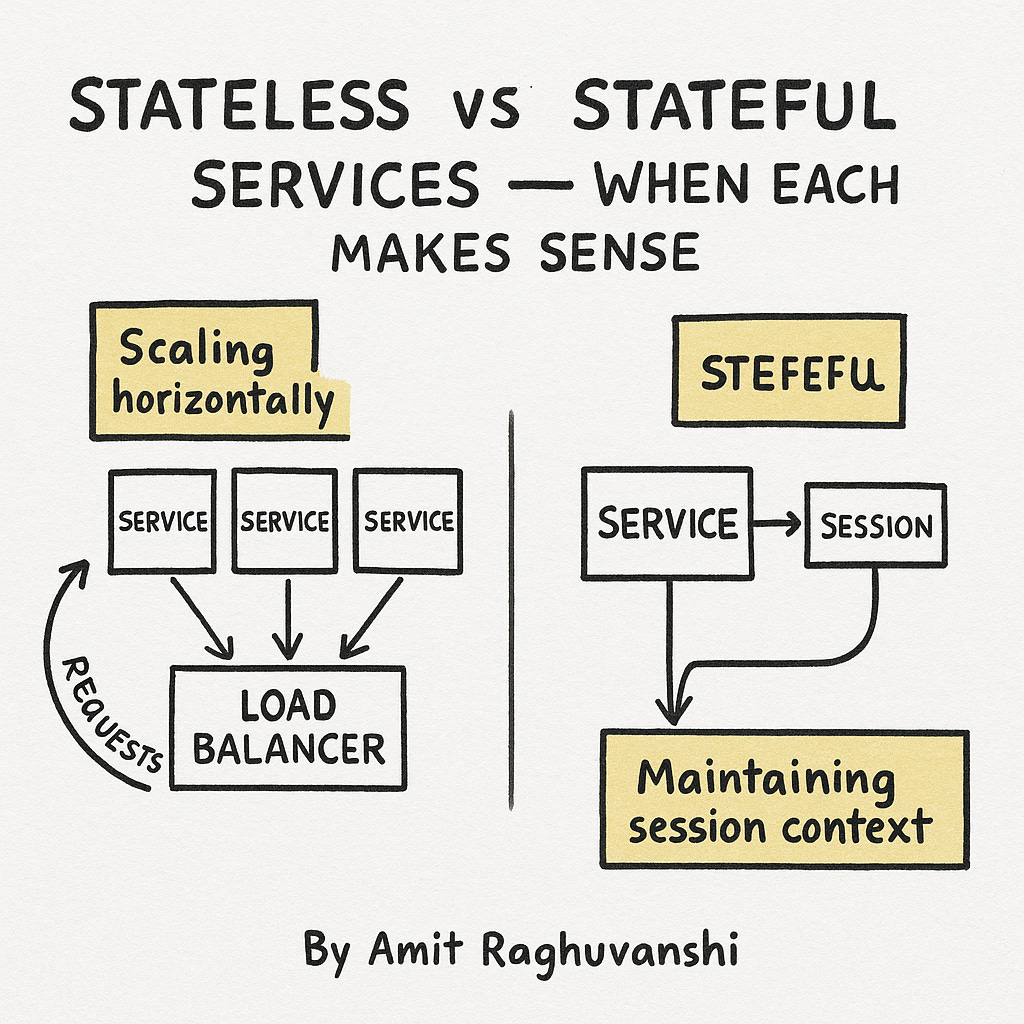
Stateless services are like Hotel Rooms. You check in, you leave, and the room is reset. The next guest doesn’t care who was there before. This makes scaling easy: need more capacity? Just build more rooms (spin up more pods). If a room breaks, move the guest to another one.
But the remaining 10% is where Architects earn their salary.
Because statelessness comes with a “Database Tax.” Every single request requires a round-trip to the database or cache to fetch context.
Let’s break it down with the real thinking you’re expected to show in an interview.
The Myth: “Stateless is always better.”
This is what many engineers believe:
“Stateless = scalable.
Stateful = bad.”
Not true.
If stateless services were always the answer,
every company would delete their databases, caches, queues, and payment processors tomorrow.
State exists everywhere — the real question is:
Where should the state live?
On the server?
On the client?
In a shared store?
Or in neither?
Let’s understand both models the right way.
What Is a Stateless Service?
A stateless service does not remember anything between requests.
Every request is independent.
No stored sessions
No connection-specific memory
No tracking of user progress
No shared in-memory data
Examples:
Most REST APIs
Image resize workers
Login API (just validates token + returns result)
Lambda / FaaS functions
When Stateless Makes Sense
You need horizontal scaling
High availability is required
Requests are short and independent
You want zero session management
You use load balancers distributing requests randomly
Stateless = simple, resilient, elastic.
What Is a Stateful Service?
A stateful service remembers something from past interactions.
Examples:
WebSockets
Multiplayer game servers
Chat servers
Long-running transactions
Payment workflows
Streaming sessions
State may include:
User session
Open transactions
In-memory buffers
Connection context
Operation progress
When Stateful Makes Sense
Real-time communication (chat, games)
Long-lived connections (WebSockets, gRPC streams)
Multi-step workflows
Anything that needs context
Stateful services are often unavoidable —
the goal is to manage the state safely, not eliminate it.
The Rule Architects Use
Here’s the rule I teach engineers:
If losing a server means losing user progress,
your service is stateful — design for resilience accordingly.
Place state carefully:
In databases (durable state)
In caches (fast state)
In queue offsets (processing state)
In sessions (authentication state)
The worst architecture is not stateless or stateful —
it is confused.
When should you break the rule and go Stateful? When latency matters more than simplicity.
Think about:
Real-time Gaming: You can’t fetch the player’s coordinates from Redis 60 times a second. The state needs to be in the server’s memory.
Collaborative Editing (Google Docs): The operational transformation logic needs to happen instantly on the server holding the document state.
Video Streaming / VoIP: The connection is long-lived and pinned to a specific handler.
The Trade-off:
Stateless: Easy to scale, harder on the database.
Stateful: Zero latency (data is in memory), but scaling is a nightmare (requires “Sticky Sessions” and complex failover).
The Takeaway
Stateless gives you scalability.
Stateful gives you capability.
Great systems use both — intentionally.
Don’t choose Stateless just because it’s trendy. Choose it because you don’t need the speed of local memory.
If your app is a CRUD API, go Stateless. If your app is a Multiplayer Game, go Stateful.
Until next time, The Architect’s Notebook
If you found this useful, share it with another engineer.
If you want more posts like this (plus full deep dives and diagrams), hit Subscribe — and join thousands of engineers leveling up their architecture skills. 🚀