

System Design Insight: How to Think Out Loud in a System Design Interview
A Step-by-Step Guide to Communicating Like an Architect

One concept, clarified in 2 minutes
By Amit Raghuvanshi | The Architect’s Notebook
🗓️ Dec 20, 2025 · Free Edition ·
If there’s one skill that consistently separates mid-level engineers from Staff-level candidates in a system design interview, it’s this:
They don’t design silently. They think out loud — clearly, concisely, and strategically.
Most candidates jump straight to drawing boxes or listing technologies.
But strong candidates narrate their thinking so the interviewer sees how they approach ambiguity, trade-offs, and complexity.
Let’s break down exactly how to do that.
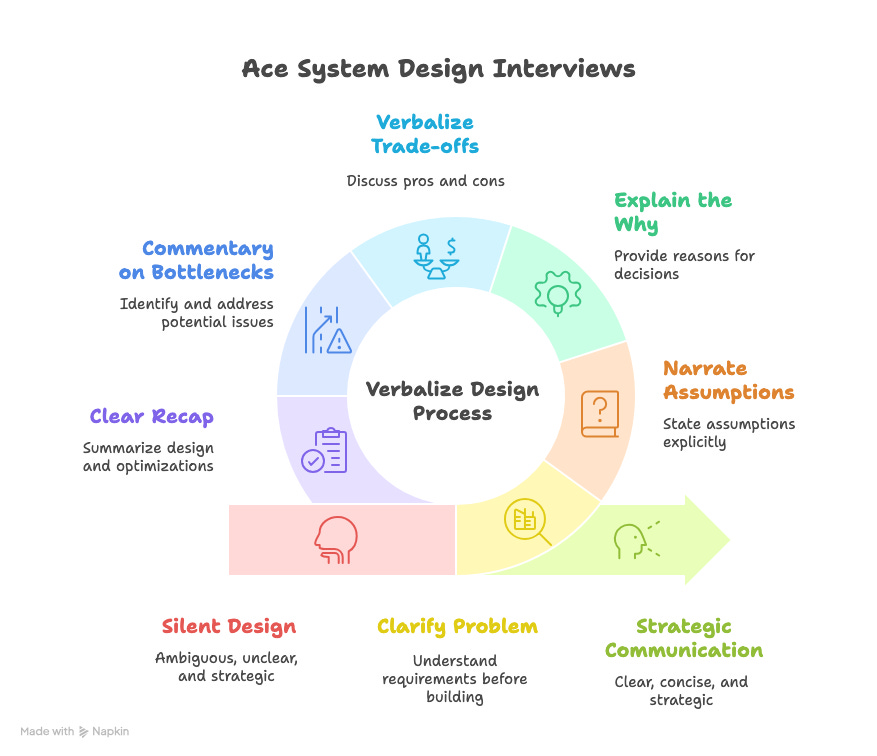
1. Start With Clarifying, Not Building
Weak candidates say:
“Okay, I’ll use Kafka, Redis, and Postgres…”
Strong candidates say:
“Before we design anything, let me clarify the problem…”
This shows the interviewer you think like an architect, not a tool-picker.
Thinking out loud here sounds like:
“Who are the primary users?”
“What’s the expected scale?”
“Is real-time required?”
“What does failure even mean for this system?”
This buys you time, earns trust, and sets a foundation for a clean design.
2. Narrate Your Assumptions
System design problems are intentionally underspecified.
Interviewers want to see your assumptions.
Try something like:
“Since the question didn’t specify traffic, I’ll assume 5M daily requests.”
“I’ll assume latency is more important than consistency here, but let me know if that’s incorrect.”
Hidden assumptions kill designs.
Stated assumptions save you.
3. Explain the Why, Not Just the What
Anyone can say:
“We’ll put a load balancer here.”
The interviewer wants the reason:
“I’m adding a load balancer here to evenly distribute traffic, avoid a single point of failure, and allow for horizontal scaling.”
The content is the same.
The communication is different — and communication gets offers.
4. Verbalize Trade-offs as You Decide
This is where most candidates freeze.
They think they’ll look unsure.
But actually, trade-off narration shows maturity.
Example:
“We could use SQL for strong consistency, or NoSQL for scale.
Since the system needs multi-row transactions, I’ll lean SQL despite the scaling challenges — we can shard later if needed.”
This demonstrates judgment — the #1 trait interviewers look for.
5. Keep a Running Commentary of Bottlenecks
As you design, keep checking yourself:
“This write path looks like a bottleneck — maybe we should queue writes.”
“This service might fail under load — let’s add retries with backoff.”
“This part needs idempotency to avoid duplicate work.”
You’re showing architectural awareness in real time.
6. End With a Clear Recap
A strong closing statement:
“To summarize: we optimized for reliability first, then scale.
The system supports horizontal growth, avoids single points of failure, and maintains consistency where needed.”
You tell the interviewer: I know what I built.
Final Thought
The interviewer is not just evaluating your design.
They are evaluating your thinking process.
Thinking out loud is how you let them see it.
Wonderful article