

Stop Memorizing System Design. Start Simulating It
Why the “System Design Masterclass” series is the blueprint you need to move from Senior Engineer to Staff Architect.

By Amit Raghuvanshi | The Architect’s Notebook
🗓️ Feb 15, 2026 ·
The “Buzzword Bingo” Problem
We have all been there. You are sitting in a System Design interview. The interviewer asks you to design a payment gateway, or a ticket booking system, or a social media feed.
Your brain immediately starts retrieving keywords from the blog posts you read last night. “I’ll use Kafka for the queue.” “I’ll use Cassandra for writes.” “I’ll use a Load Balancer for traffic.”
And then, the interviewer asks the one question that destroys your entire design: “Why?”
“Why Kafka? What happens if the consumer crashes before processing the message? Do you lose the payment? If you use enable.auto.commit=false, how do you handle the duplicate message when the consumer restarts? Now you’ve charged the user twice. How do you fix that?”
Silence.
This is the moment where 90% of engineers fail. They fail not because they don’t know the tools, but because they don’t know the Physics of Engineering. They have memorized the “What” (the tools), but they have never simulated the “How” (the failure modes).
This gap—between knowing the definition of “Sharding” and knowing what happens when a shard becomes a Hot Key during a Black Friday sale—is the difference between a Senior Engineer and a Staff Architect.
This is exactly why I wrote the System Design Masterclass series.
I was tired of seeing talented engineers fail because they were studying “Theory” instead of “Reality.” This series is not a textbook. It is a Simulation. It forces you into the War Room to solve the messy, chaotic, high-stakes problems that actually define modern software architecture.
Here is why this series is different from anything else on the market, and why it is the only toolkit you need to architect your future.
1. The Philosophy: Simulations, Not Lectures
Most System Design books are dictionaries. They give you a chapter on “Load Balancers,” then a chapter on “Caching,” then a chapter on “Databases.” You read them, nod your head, and feel smart.
But when you try to combine them, you realize you don’t know how they interact.
The System Design Masterclass series is built on a “Loop-Based Simulation” model. I don’t lecture you. instead, I drop you into a scenario.
The Structure of Every Chapter:
The Prompt: “Design a Core Banking Ledger that handles 50,000 TPS.”
The Junior Trap: I show you the solution that most candidates provide—and then I show you exactly why it breaks. We watch the database crash. We watch the money disappear. We feel the pain of the bad design.
The Staff Evolution: We iteratively rebuild the system. We don’t just “add Redis.” We discuss eviction policies. We don’t just “add a database.” We discuss isolation levels and locking strategies.
The Insights: At the end of every simulation, I break down the mathematical and architectural “Why” behind the decisions.
This format mimics the actual interview process. It trains your brain to anticipate the interviewer’s critique before they even speak.
Download the Free Sample of Vol 1 here.
To read the Vol 1 book’s excerpt on Substack click here.
2. The Curriculum: The Phase 1 Kit
To truly transition to a Staff+ role, you need to master three specific domains: Financial Correctness, Extreme Concurrency, and Data Integrity.
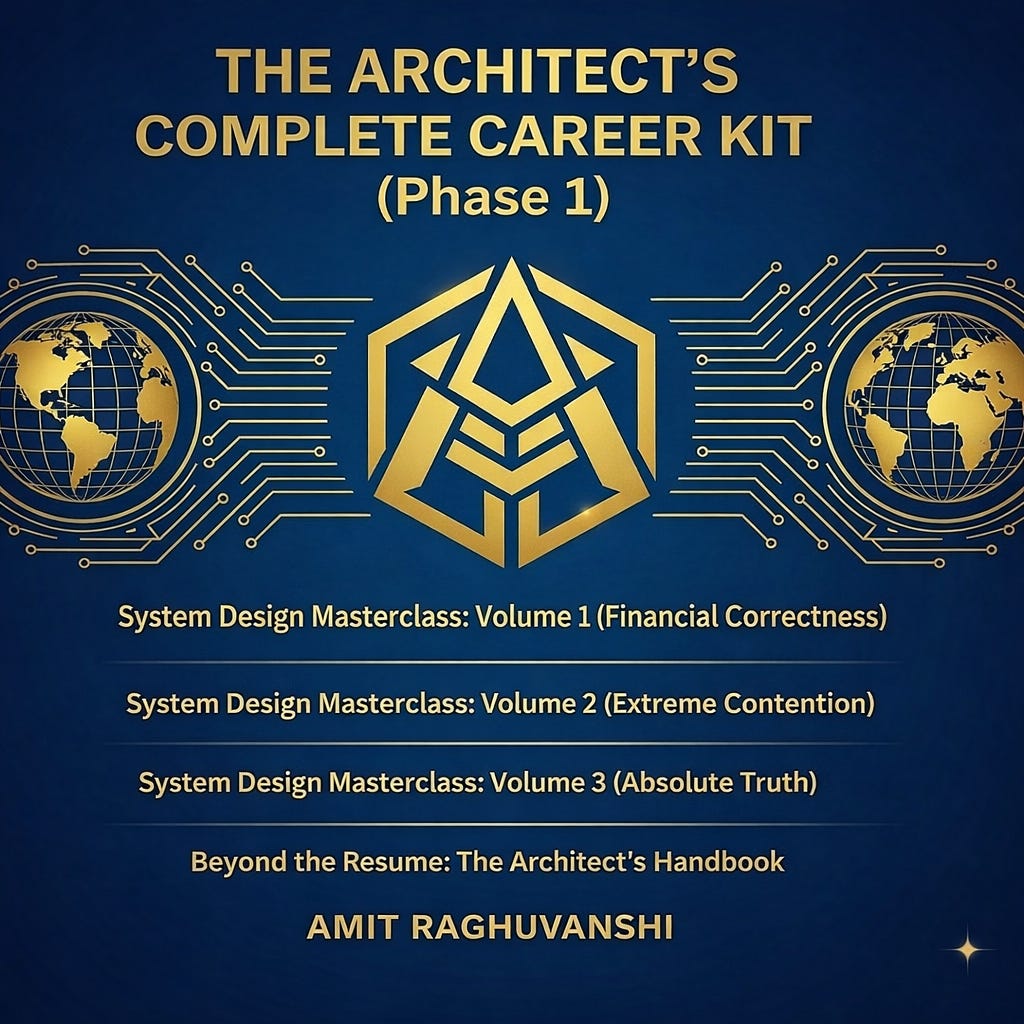
I have bundled these into The Architect’s Complete Career Kit (Phase 1). Let’s break down exactly what you get in each volume.
Volume 1: Financial Correctness (The Payments Engine)
The Book on Idempotency. (200+ Page book)
Most engineers are terrified of writing code that handles money. Rightfully so. If you drop a log line, no one cares. If you drop a payment, you get sued.
In Volume 1, we tackle:
The Idempotency Key: How to ensure that no matter how many times a user clicks “Pay,” or how many times the network times out, we only charge them once. We go deep into the
Idempotency-Keyheader and state management.The Double-Charge Problem: We simulate race conditions where two parallel requests try to withdraw funds from the same wallet. We move beyond simple database constraints and look at distributed locking.
The Payment State Machine: You will learn why “Boolean” flags (
is_paid = true) are amateur hour. We build robust State Machines that handleCREATED,AUTHORIZED,CAPTURED,REFUNDED, and the dreadedFAILED_RETRYABLE.Reconciliation: What happens when your database says “Success” but PayPal says “Failure”? We design the “Recon” jobs that run at night to fix the discrepancies that inevitably happen in distributed systems.
Outcome: You will never be afraid of designing a Fintech system again.
Volume 2: Extreme Contention (The Traffic Spike)
The Book on Locking & Caching. (200+ Page book)
It’s easy to design a system for 10 users. It’s hard to design a system for 10 million users. It’s excruciatingly hard to design a system where 10 million users are trying to buy the same 500 tickets.
In Volume 2, we tackle:
The Thundering Herd: We analyze what happens when a cache key expires and 50,000 requests hit your database in 10 milliseconds. We implement “Probabilistic Early Expiration” and “Request Coalescing” to save the DB.
Inventory Management: How do you handle “High Contention” inventory (like iPhone pre-orders)? We prove why standard SQL
SELECT FOR UPDATEkills your throughput and how to move to Redis Lua Scripts for atomic, in-memory inventory deductions.The Waiting Room: We design the “Virtual Queue” architecture used by Ticketmaster and Cloudflare to protect backend infrastructure during massive surges.
Rate Limiting: We move beyond the “Token Bucket” theory and implement “Distributed Rate Limiting” using Redis and Sliding Windows, discussing the trade-offs of accuracy vs. latency.
Outcome: You will learn to survive Black Friday.
Volume 3: Absolute Truth (The Banking Ledger)
The Book on Data Integrity. (500+ Page book)
This is the newest and most advanced addition to the series. We leave the world of “Eventual Consistency” behind. In banking, “eventual” means “wrong.”
In Volume 3, we tackle:
Double-Entry Accounting: We stop treating databases like buckets of money and start treating them like ledgers. You will learn the rigid “Debit = Credit” immutable log architecture that powers the world’s banks.
The PACELC Theorem: CAP theorem is for 2010. We dive into PACELC (Partition, Availability, Consistency, Else Latency, Consistency). We analyze why we choose Latency over Consistency in banking (or vice versa) and the cost of those decisions.
Distributed Consensus: How do we ensure that a transaction is committed across multiple nodes without split-brain? We touch on the practical application of consensus algorithms.
The Audit Trail: We design systems that are not just correct, but provably correct. We use cryptographic chaining (Merkle Trees) to ensure that no rogue admin can rewrite history without detection.
Zero-Downtime Migrations: We simulate “The Heart Transplant”—migrating petabytes of financial data from a legacy monolith to a new microservice without stopping the world or losing a cent.
Outcome: You will learn to architect the “Source of Truth.”
3. The “Soft” Skill: Getting the Interview
You can have all the technical knowledge in the world, but if your resume gets rejected by the ATS (Applicant Tracking System), it doesn’t matter.
That is why the Phase 1 Bundle includes my distinct career guide:
Beyond the Resume: The Architect’s Handbook
The Book on Hiring Psychology. (200 Page book)
This is not a generic “Resume Tips” blog post. This is a strategic guide on how to position yourself as a leader.
We cover:
The “Impact” Rewrite: How to stop listing “Responsibilities” (what you did) and start listing “Impact” (what you achieved). We rewrite actual bullet points from “Used Java and SQL” to “Reduced API latency by 40% by implementing a Redis Read-Through cache.”
The ATS Algorithm: Understanding how the robots read your resume and how to format your keywords to get flagged for human review.
The Behavioral Interview: How to answer “Tell me about a time you failed.” We use the STAR method, but tailored for Engineering Leadership.
Negotiation: The psychology of the offer letter. How to know your worth and ask for it.
Outcome: You stop applying into the void and start getting calls from Recruiters.
4. The Future: A Complete Roadmap
When you invest in the System Design Masterclass series, you aren’t just buying a PDF. You are buying into a curriculum. I am building the most complete repository of engineering knowledge available.
Here is what is coming next (The Phase 2 Roadmap):
Volume 4: The Social Graph (Q1 2026): We will tackle Graph Databases, Fan-out-on-Write vs. Fan-out-on-Read, and how to build “Infinite Scroll” feeds that process billions of relationships.
Volume 5: Multi-Tenancy & B2B (Q2 2026): We will explore the “SaaS Nightmare.” Designing for isolation, “Noisy Neighbor” problems, and sharding data not by ID, but by Tenant.
Volume 6: The Cloud Native Architect (Q3 2026): We will build our own mini-Kubernetes. Service Mesh, Sidecars, Circuit Breakers, and the architecture of Container Orchestration.
By starting with Phase 1 now, you are laying the foundation for these advanced topics.
5. Why the “Phase 1 Bundle” is a No-Brainer
We sell these books individually because some engineers have specific gaps. But for those serious about a career transformation, we created The Architect’s Complete Career Kit (Phase 1).
What’s Inside:
The Value: If you bought these separately, it would cost you $156. We have priced the bundle at $149 (For Everyone).
For Lifetime Members (Best Value - 15% OFF):
Your Price: $132 (Save ~$24 off the total cover price).
Check your “Lifetime VIP” email for your exclusive code.
For Yearly Members (10% OFF):
Your Price: $140 (Save ~$16 off the total cover price).
Check your latest “Member Only” email for your code.
Let’s look at the math for Lifetime Members: At $132, you are securing the entire library for a steal. The savings on this bundle alone are a significant return on your lifetime investment. It pays to be in the inner circle.
(Note: These discounts include the existing bundle savings. Codes have been sent to your inbox (or ping me to get the code)!)
Already own a book? If you already bought Volume 1 or 2 and want to upgrade to the bundle, do not buy it full price! Reply to this email or DM me. I will verify your purchase and send you a custom discount link that deducts exactly what you paid from the bundle price. You will never pay twice for the same content.
Here is a ready-to-use 'Manager Approval' template you can use to expense any book, bundle, or resource from The Architect's Notebook.
Conclusion: The Cost of Stagnation
The tech industry is changing. The era of “Leetcoding” your way into a generic Senior role is ending. Companies are looking for Problem Solvers. They are looking for Architects who understand trade-offs, who can protect data, and who can design systems that survive failure.
You can spend 2026 reading random blog posts and hoping you memorize the right buzzwords.
Or, you can invest less than the cost of a mechanical keyboard to get the blueprint.
These books are the mentorship I wish I had 10 years ago. They are the simulations that will give you the “War Stories” you need to impress a Principal Engineer in an interview.
Don’t just write code. Architect systems.
See you in the simulations.
Amit Raghuvanshi
Sounds brilliant.
You probably would benefit from provinding a small example of a simulation, to see what the actual content looks like!