

Ep #115: Zero-Downtime Data Architecture (Part 1): The Fundamental Constraint
Why your "rolling deployment" is secretly a database time bomb, and the engineering philosophy required to fix it.

By Amit Raghuvanshi | The Architect’s Notebook
🗓️ Jun 9, 2026 · Deep Dive ·
A few weeks ago, I received an email from Srini, a reader and freelance architect with two decades of industry experience. He pointed out a massive gap in how we discuss distributed systems: we talk endlessly about scaling up, but we rarely discuss the sheer terror of upgrading a live database. Schema changes, index rebuilds, and major version upgrades are the silent killers of system availability. Today, inspired by Srini’s email, we are kicking off a new series focused purely on production survival: The Zero-Downtime Architecture Series.”
1. The Real Cost of Downtime
Zero-Downtime Data Architecture (ZDDA) is a collection of engineering patterns, deployment strategies, and data management techniques that allow software systems — including their databases — to be continuously updated, scaled, and maintained without ever taking the system offline or causing service interruptions visible to end users.
The critical word here is “data”. Most engineers are familiar with zero-downtime application deployments (blue-green, rolling updates in Kubernetes). But the database layer is fundamentally harder. The database is stateful, shared, and unforgiving.
A schema change gone wrong can lock a 500-million-row table for 45 minutes.
A bad migration can corrupt data irreversibly.
A botched rollback can leave you in a state worse than the outage itself.
Zero-Downtime Data Architecture specifically addresses:
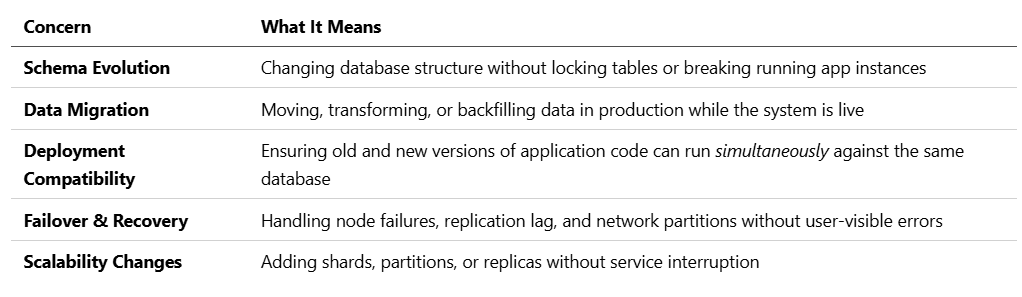
1.1 The Financial Impact
The cost of downtime is staggering. For a mid-market SaaS company, downtime averages $5,000 to $25,000 per minute. Facebook’s famous 2021 outage cost an estimated $60 million in direct revenue.
But beyond money, scheduled maintenance windows create a toxic engineering culture. Teams normalize the idea that downtime is acceptable. Deployments become rare, high-risk events. Fear of deployments leads to massive, infrequent releases—which are themselves statistically more likely to break production.
1.2 Beyond Money: The SLA Problem
Most B2B software companies commit to SLAs (Service Level Agreements) in their contracts:
99.9% uptime = 8.7 hours of downtime allowed per year
99.95% uptime = 4.4 hours of downtime allowed per year
99.99% uptime = 52 minutes of downtime allowed per year
99.999% uptime = 5.26 minutes of downtime allowed per year (”five nines”)
A single 2-hour maintenance window for a database migration can consume your entire annual SLA budget for 99.99% uptime agreements. For healthcare, finance, and government systems, missing SLAs means financial penalties, regulatory action, and contract terminations.
1.3 The Engineering Culture Problem
Scheduled maintenance windows create a dangerous engineering culture:
“We’ll fix it in the next maintenance window” — delays urgency
Teams normalize the idea that downtime is acceptable
Deployments become rare, high-risk events instead of routine operations
Fear of deployments leads to large, infrequent releases — which are themselves more risky
Zero-downtime architecture enables continuous deployment, which statistically results in fewer incidents because changes are smaller, more frequent, and easier to roll back.
2. The Fundamental Constraint
To understand ZDDA, you must understand the hardest constraint in modern software delivery:
During any deployment, multiple versions of your application code will run simultaneously against the same database.
This means your database schema must be compatible with both the old version (v1) and the new version (v2) of your application at the same time. Let’s try to understand this with the deployment timeline.
Timeline of a Kubernetes Rolling Deployment:
t=0:[v1] [v1] [v1] [v1]← All pods on the old versiont=1:[v2] [v1] [v1] [v1]← One pod updatedt=2:[v2] [v2] [v1] [v1]← Two pods updatedt=3:[v2] [v2] [v2] [v1]← Three pods updatedt=4:[v2] [v2] [v2] [v2]← All pods updated
During t=1 to t=3, BOTH v1 and v2 hit the exact same database. This means your database schema must support BOTH at the same time. You cannot simply rename a column, because v1 expects the old name and v2 expects the new name. This single constraint is the root cause of almost every zero-downtime data engineering challenge.
🔒 Subscribe to read The Core Philosophy & The Pillars of ZDDA
How do we solve the constraint of simultaneous versions? We have to decouple our deployments from our migrations, and we have to abandon the idea of the “perfect” schema change.
In the rest of this deep dive, we will cover:
The 4 Pillars of ZDDA: Backward compatibility, Decoupling, Eventual Consistency, and Observability.
The
ALTER TABLEProblem: Why running a standard SQL migration script on a large table is mathematically guaranteed to cause an outage.The Expand & Contract Pattern (Intro): A preview of the gold-standard pattern used by Stripe and GitHub to evolve schemas without locking.
The Philosophy and The Math
3. The Core Philosophy: Design for Failure
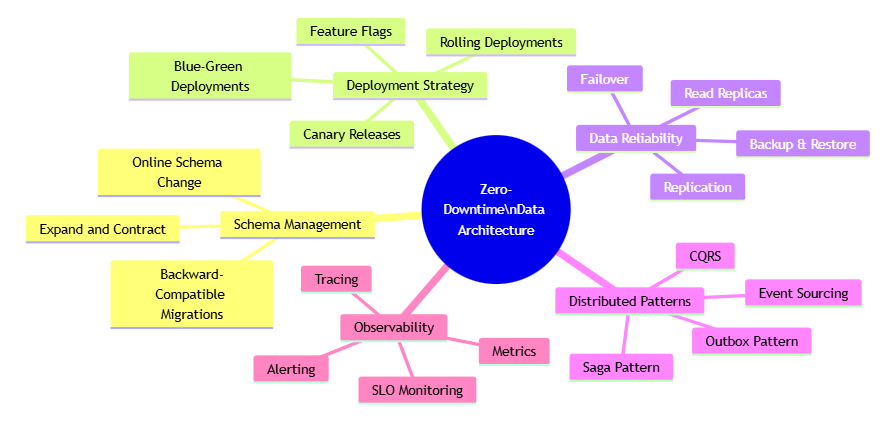
Zero-Downtime Data Architecture rests on four philosophical pillars:
3.1 Backward Compatibility Over Perfection
Never make a breaking change in a single step. Every change should be backward-compatible. The perfect schema design is irrelevant if getting there breaks production. You must break the change into multiple safe, backward-compatible steps.
3.2 Decouple Application Deployment from Schema Changes
Schema changes and application deployments are not the same event. They must be decoupled. The database schema should be changed in a separate, earlier step — before the application code that uses the new schema is deployed. And the old schema should be removed in a separate, later step — after the old application code is fully gone.
WRONG approach (coupled):
Deploy v2 code + Run migration at same time = RISK

RIGHT approach (decoupled):
Step 1: Run backward-compatible migration (schema now supports both v1 and v2)
Step 2: Deploy v2 code (rolls out gradually; both v1 and v2 pods work fine)
Step 3: Verify v2 is stable
Step 4: Run cleanup migration (remove old schema that v1 needed)
3.3 Embrace Eventual Consistency
Strong consistency during a migration is expensive and requires locking. Zero-downtime systems often trade immediate consistency for eventual consistency (e.g., backfilling data in the background).
3.4 Observability Is Non-Negotiable
You cannot operate a zero-downtime system blindly. You must have:
Real-time metrics (query latency, error rates, replication lag)
Distributed tracing across services
Alerting on anomalies before they become outages
Dark launch / canary analysis capabilities
3.5 The Pillars of Zero-Downtime Architecture
4. The Mathematical Proof: Why ALTER TABLE is a Time Bomb
In most relational databases, a naive ALTER TABLE statement acquires an exclusive lock on the entire table for the duration of the operation. No reads. No writes. Just waiting.
-- This single statement on a 500M row table can lock production for 45 MINUTES:
ALTER TABLE users ADD COLUMN full_name VARCHAR(255);

-- Or even worse, renaming a column:
ALTER TABLE orders RENAME COLUMN user_id TO customer_id;

-- Or changing a data type:
ALTER TABLE events ALTER COLUMN payload TYPE JSONB USING payload::JSONB;
Let’s prove mathematically why running a naive ALTER TABLE on a large table is impossible if you want zero downtime.
Let’s calculate the lock time for a full table rewrite: Time = (Rows * BytesPerRow) / DiskIOThroughput
N = 500,000,000 rows
R = 200 bytes per row
D = 500 MB/s (fast SSD)
T = 100,000 MB / 500 MB/s = 200 seconds (3.3 minutes)
But that is the best-case theoretical physics limit. In reality, index rebuilding and redo log overhead push this to 15-30 minutes.
The Blast Radius: If your application serves 1,000 requests/second that touch this table, a 15-minute lock results in 900,000 failed requests.
During all of that time, every query against that table is blocked. Your application shows errors, timeouts pile up in connection pools, and your load balancers mark pods as unhealthy. It’s a full production outage.
But here’s the deeper problem that most engineers miss:
Even if your database supports online DDL (like MySQL 8’s
ALGORITHM=INPLACE), renaming a column is still a breaking change. The old application code will immediately break because it references the old column name.
This is why we need the Expand and Contract Pattern.
Summary of Part 1
We have established the rules of the game: You cannot run ALTER TABLE on large tables, and your schema must support two versions of the app simultaneously. So, how do we rename a column or change a data type without locking the database?
In Part 2, we will dive deep into SQL. We will learn the Expand and Contract Pattern, phase by phase, with the exact SQL scripts and C# code needed to achieve zero-downtime schema evolution.
Keep Architecting.
P.S. Mastering these concepts is the difference between a mid-level developer and a true Architect. If you are tired of guessing how to handle network partitions, consistency models, and global latency, I have compiled everything I know into my System Design Masterclass book series.
5 volumes are now live. Whether you need to understand the metal layer of infrastructure, or you are looking to master the architecture of global engagement, these books contain the definitive blueprints.
Volume 1 taught us Financial Correctness (Payments, Sagas, Idempotency).
Volume 2 taught us Extreme Contention (Inventory, Race Conditions).
Volume 3 taught us Absolute Truth(Ledgers, PACELC, Append-Only Logs).
Volume 4 taught us Read-Heavy Scale(Global Engagement, Fan-out, Feeds).
Volume 5 taught us Distributed-Counter (Youtube video views, Unique viewers).